Blogs for Peter Avila
How to Display the Elapsed Processing Time of a Report in SSRS
The amount of time it takes to process a report can be useful information for performance auditing. Although there isn’t a built-in field in SQL Server Reporting Services that holds the elapsed processing time, it’s easy to create this functionality using the ExecutionTime built-in field and the Now VB.Net function in SSRS. For instructor-led SQL … Continue reading How to Display the Elapsed Processing Time of a Report in SSRS
Optional Parameters in SSRS
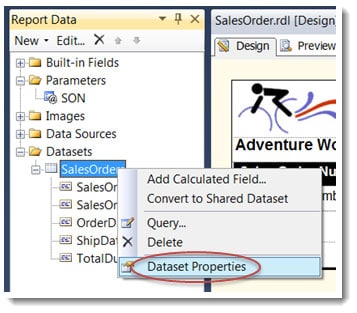
Let’s say you have a report, like a sales report that shows sales orders, and some people who run that report need it to show only the one sales order that they specify while others need to see all sales orders. In this article, I’ll show you how to create an optional parameter that allows … Continue reading Optional Parameters in SSRS
A Real-World Example of a Non-Correlated SELECT Subquery and Cross Join
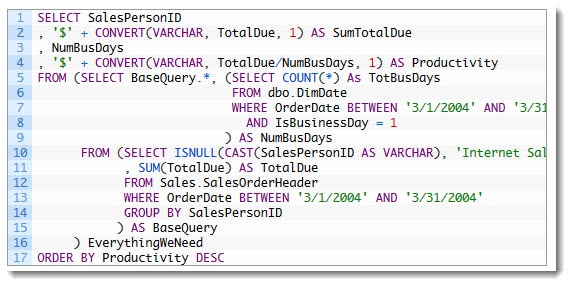
I recently developed a solution to a problem that is a good example of a non-correlated subquery in a SELECT clause that can also be written as a cross join. I’ll describe the requirement, the data, and then the solution with a non-correlated subquery and another with a cross join. To keep my client and … Continue reading A Real-World Example of a Non-Correlated SELECT Subquery and Cross Join
Repeating and Freezing Column Headers in SSRS Tables
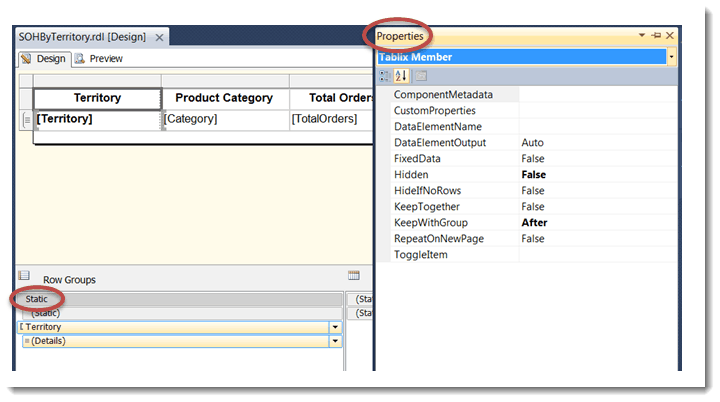
In this article I’ll show you how to configure a table tablix to both repeat column headers at the top of every page and freeze them while scrolling. While tablixes have properties for these things, they only work in matrix tablixes but not in tables. I’ll show you a way to accomplish these things using … Continue reading Repeating and Freezing Column Headers in SSRS Tables
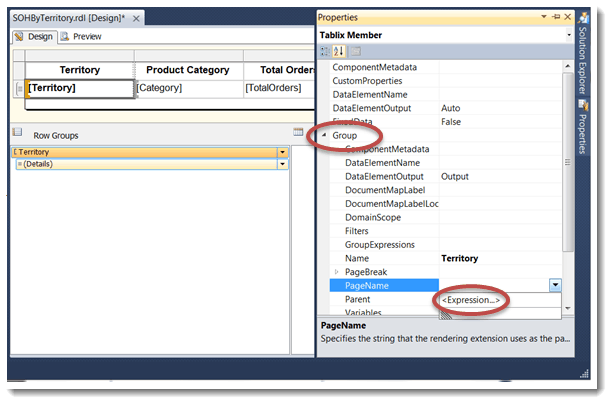
How to Name Worksheets When Exporting SSRS reports to Excel
Let’s say we have the following report that shows total sales by product category by territory: When we export this report to Excel, we’d like each territory to appear in its own worksheet and each worksheet named after its territory: How do we make this work? Easy! 1) Put every group on its own page, … Continue reading How to Name Worksheets When Exporting SSRS reports to Excel
Using Custom Code in SSRS
While expressions allow you to use limited VB.Net to create advanced dynamic functionality in your SQL Server Reporting Services (SSRS) reports, custom code allows you to leverage much more of the power of VB.Net. The focus of this article is not on writing VB.Net code, but on how to create and use code in SSRS. … Continue reading Using Custom Code in SSRS

How to Display Blanks as Zeros in a SSRS Report
Some of the cells in this SSRS matrix report are blank: To display zeros instead, we will use two functions: 1. IsNothing(<Val2Check>) returns a True of Val2Check is Null; otherwise, it returns False 2. IIF(<Test>, <IfTrue>, <IfFalse>) return <IfTrue> if <Test> is True; otherwise, it returns <IfFalse> In the design of the matrix, right-click … Continue reading How to Display Blanks as Zeros in a SSRS Report

Project Management (PMP) for Executives – Introduction
Introduction Project Management (PMP) for Executives is a 9 part video training series developed by Steve Fullmer, PMP, MBA, MCT/CTT+, CDP. Steven has a global reputation as a project manager, chief technology officer, and computer systems innovator. He has authored more than 100 articles and a dozen courses in the fields of project management, productivity, business … Continue reading Project Management (PMP) for Executives – Introduction
Project Management (PMP) Leadership Skills in the 21st Century … Do you Know Your History? – November 10, 2017
The PMI Leadership triangle touts our need to develop our knowledge and application of leadership. Do you understand the leadership models of the 20th century? The 21st Century? Understanding your predecessors can assist to set your future course. On the matter of history, Mark Twain’s quote “History doesn’t repeat itself, but it does rhyme” is … Continue reading Project Management (PMP) Leadership Skills in the 21st Century … Do you Know Your History? – November 10, 2017
Principles of Decision Tree Design and Analysis in Project Management (PMP)
In this Project Management Professional (PMP) training video, learn how about Decision Trees and how to solve them with Risk Analysis. Existentialism conveys themes like the importance of choice, contingencies, and extreme situations. How do you choose when the decision is hard? (If the decision is easy, you just choose.) When the decision is hard, we … Continue reading Principles of Decision Tree Design and Analysis in Project Management (PMP)
Understand the Mind to Become a Better Project Manager – February 18, 2015
Our minds all work alike, at least biologically. Yet we are a diverse species with different motivations, opinions, perspectives, and directions. Do you understand how and why the human mind works? What makes you a great project manager? In this recording of our PMP training webinar from February 18, 2015, Steve Fullmer covers some of … Continue reading Understand the Mind to Become a Better Project Manager – February 18, 2015
Windows 10 Security – What’s New and Improved? – December 3, 2015
In this recording of our Windows 10 webinar from December 3, 2015 training, security expert Mike Danseglio presents the enhanced security features of SmartScreen, Defender and BitLocker in Windows 10 and new features such as Biometric Identification, Microsoft Passport, Device Guard and more.
Windows 10 Managing, Deploying and Configuring – December 2, 2015
In this recorded Windows 10 training webinar from December 2, 2015, Windows Server instructor Rick Trader presents the deployment and management of Windows 10 Enterprise and the new Provisioning capability in Windows 10. Learn how to manage Windows 10 deployments using System Center Configuration Manager, Mobile Device Management and Intune. Also included in his presentation … Continue reading Windows 10 Managing, Deploying and Configuring – December 2, 2015
A Simple Introduction to Cisco CML2
Mark Jacob, Cisco Instructor, presents an introduction to Cisco Modeling Labs 2.0 or CML2.0, an upgrade to Cisco’s VIRL Personal Edition. Mark demonstrates Terminal Emulator access to console, as well as console access from within the CML2.0 product. Hello, I’m Mark Jacob, a Cisco Instructor and Network Instructor at Interface Technical Training. I’ve been using … Continue reading A Simple Introduction to Cisco CML2
Creating Dynamic DNS in Network Environments
This content is from our CompTIA Network + Video Certification Training Course. Start training today! In this video, CompTIA Network + instructor Rick Trader teaches how to create Dynamic DNS zones in Network Environments. Video Transcription: Now that we’ve installed DNS, we’ve created our DNS zones, the next step is now, how do we produce those … Continue reading Creating Dynamic DNS in Network Environments
Cable Testers and How to Use them in Network Environments
This content is from our CompTIA Network + Video Certification Training Course. Start training today! In this video, CompTIA Network + instructor Rick Trader demonstrates how to use cable testers in network environments. Let’s look at some tools that we can use to test our different cables in our environment. Cable Testers Properly Wired Connectivity … Continue reading Cable Testers and How to Use them in Network Environments


